



If you trade index futures, understanding contract rollover is a core skill. While rollover week may look quiet on the surface, it introduces subtle changes in liquidity, execution quality, and market behaviour that can catch unprepared traders off guard.
What Is Contract Rollover in Futures Trading?
Contract rollover is the process by which trading activity shifts from an expiring futures contract to the next available contract in the quarterly cycle.
Index futures such as ES (E-mini S&P 500) and NQ (E-mini Nasdaq 100) are listed on a quarterly schedule. Each contract has a defined expiration, and before that date arrives, market participants begin transferring positions to the next contract.
What matters most during contract rollover is liquidity migration:
- Volume gradually leaves the expiring contract
- The new contract becomes the primary trading vehicle
- Market behaviour often becomes slower and more rotational
This transition directly affects fills, volatility, and the reliability of technical references.
Monitoring Volume for the Contract Rollover
A contract rollover occurs when trading volume shifts from the expiring contract to the next. There is no fixed calendar date for this transition; volume is the deciding factor.
To confirm the rollover, traders monitor contract-level volume directly on the CME, which shows where trading activity is concentrated: CME Volume & Open Interest Page.
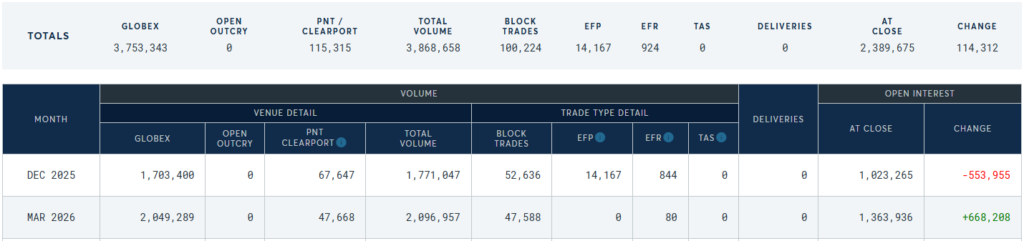
Once the majority of volume has moved to the new contract, the rollover is executed. At that point, the ticker symbol should be updated on platforms like ATAS so execution, order flow, and analysis remain aligned with the most liquid contract.
How to Handle the Rollover Correctly
Follow Volume, Not the Calendar
One of the biggest mistakes traders make during contract rollover is switching contracts based only on the expiration date. A more reliable approach is:
- Monitor volume on both contracts
- Switch when the new contract clearly leads in volume
- Execute and analyse on the same active contract
Trade the Active Contract, Not Just Continuous Charts
Continuous charts can be helpful in the long term, but they do not represent a tradable instrument. During contract rollover:
- Execution should always occur on the active contract
- Market profile, volume tools, and order flow should reflect the same contract
This avoids discrepancies between analysis and execution. Precision becomes especially important during transitional weeks.
Reset Expectations During Rollover Week
Rollover week is structurally different from a typical trading environment. That means that we can have fewer high-quality opportunities, more choppy environments, and less follow-through. It’s also possible we’ll see increased noise around key levels.
Tips for Trading Contract Rollover Week
Trade selection:
- Favour scalps over extended day trades
- Be selective with entries
- Expect range-bound behaviour more often than trends
Levels and structure:
- Treat old levels with caution early in the new contract
- Allow time for value, ranges, and references to rebuild
- Let acceptance and rejection guide your bias
Risk Management:
- Reduce trade frequency if conditions deteriorate
- Avoid forcing setups that don’t fit the environment
- Be extra cautious if rollover overlaps with major economic news
ES and NQ Contract Rollover Schedule for 2026
Futures contracts follow a standard quarterly cycle: March (H), June (M), September (U), December (Z).
ES Futures Contracts – 2026
- ESH26 – March 2026
Rollover typically occurs in mid-December 2025 - ESM26 – June 2026
Rollover typically occurs in mid-March 2026 - ESU26 – September 2026
Rollover typically occurs in mid-June 2026 - ESZ26 – December 2026
Rollover typically occurs in mid-September 2026
NQ Futures Contracts – 2026
- NQH26 – March 2026
Rollover typically occurs in mid-December 2025 - NQM26 – June 2026
Rollover typically occurs in mid-March 2026 - NQU26 – September 2026
Rollover typically occurs in mid-June 2026 - NQZ26 – December 2026
Rollover typically occurs in mid-September 2026
Conclusion
Contract rollover is a market structure event. When liquidity shifts, behaviour changes, and traders who fail to adapt often mistake that change for “bad market conditions.” In reality, the market is simply transitioning, and it demands a different approach.
The most important adjustment is understanding that volume defines the active contract. Trading the contract with the highest liquidity keeps execution clean and ensures your analysis reflects what the market is trading.
Traders who respect rollover don’t try to force day trades. They focus on high-quality setups, lean toward scalps, and allow new levels to develop naturally as the contract establishes itself.
Mastering contract rollover will make your trading more consistent. And in the long run, consistency is what keeps you in the game.
If you want to learn how to navigate contract rollover transitions smoothly and avoid common mistakes, Chart Champions provides the guidance and support to do it the right way.