



A demo trading account is the safest way to begin your trading journey. It lets you practise strategies, explore order-flow tools, and build confidence, all without risking any real capital.
Yet many new traders skip this vital step. They jump straight into live markets and quickly find themselves overwhelmed by stress and emotion.
Starting with a demo trading account removes that pressure completely. It gives you the freedom to make mistakes, test new ideas, and understand how the market moves before you ever put money on the line.
In this guide, you’ll learn how to set up a demo trading account in ATAS, connect a data feed, and start practising in live-market conditions using cryptocurrencies and futures.
Why Use a Demo Trading Account?
Trading is a skill, and every skill improves through repetition and observation. A demo trading account allows you to:
- Familiarise yourself with trading platforms. Learn how to navigate charts, tools, and order types without fear of mistakes.
- Understand order execution. Experiment with limit, market, and stop orders until you’re comfortable with each.
- Test and refine your strategies. Try different approaches and measure performance before going live.
- Build emotional discipline. Trading without financial risk helps you focus on the process rather than the outcome.
This phase is your training ground. You’re developing habits, structure, and consistency, not chasing profits.
Differences Between Demo and Live Trading Accounts
While a demo trading account is a perfect environment for learning, it cannot replicate the live market exactly.
So, once you move to real trading, you’ll notice a few key differences:
- Execution speed. Live orders can face slight delays.
- Liquidity conditions. Large orders may not always be filled instantly; in a demo, they usually are.
- Spread and slippage. Bid-ask spreads fluctuate in real markets, sometimes affecting your entry and exit prices.
These subtle variations make live trading feel more intense, which is why it’s crucial to build consistency first in your demo phase.
Tip: When you finally go live, keep your position sizes small. The goal isn’t to earn, it’s to test how your mindset adapts when real money is involved.
Setting Up a Free Demo Trading Account on ATAS
ATAS is one of the most advanced order-flow trading platforms, widely used by both crypto and futures traders.
One of its best features? You can start with a free demo trading account. Ideal for practising before risking any real money.
Let’s walk through the setup process step by step.
Step 1: Create Your ATAS Account
Register a new account on their website if you don’t have one yet.
Step 2: Download and Install the ATAS Platform
Once registered, download the installer from the ATAS website. Run the setup file and follow the installation wizard.
Note: ATAS is currently available for Windows only, but a Beta version for Mac is already in testing, with a full release coming soon. Mac users can still run ATAS via Parallels or similar software. Before installing, check the system requirements.
Step 3: Connect to a Demo Trading Account for Crypto
Inside the ATAS dashboard, head to the Connections section.
You’ll find two key options:
- Crypto SIM: acts as your demo trading account.
- Crypto Data: provides the live market data feed.
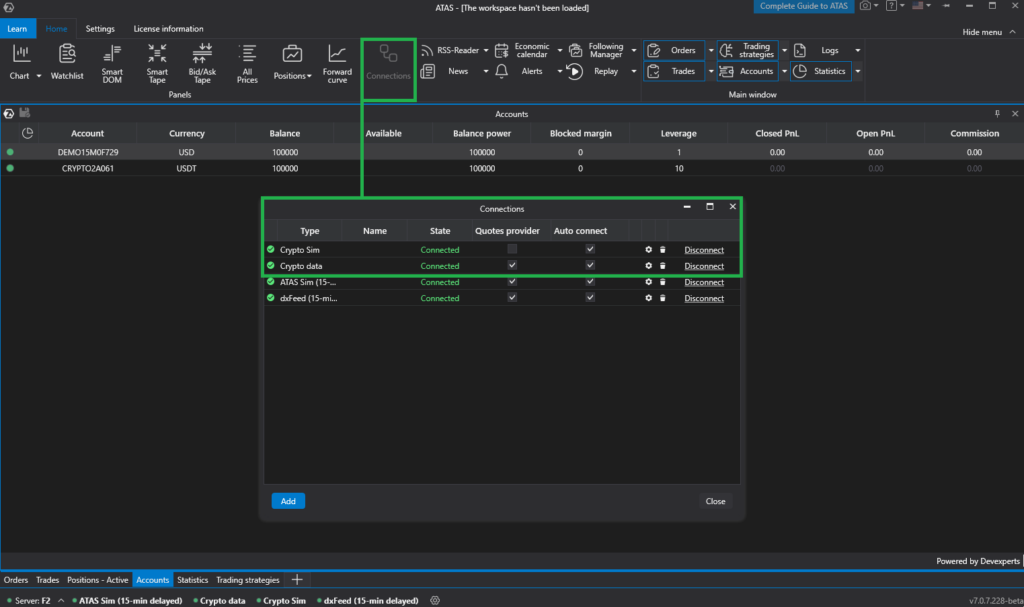
Make sure both are connected. Once active:
- Your demo account will be automatically funded with $100,000 in virtual capital.
- You can reset this balance at any time if you want to start fresh.
Then, open a chart:
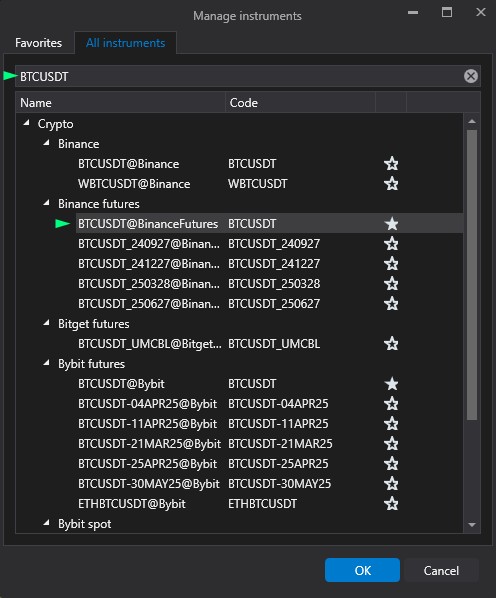
- Click Chart to open the Manage Instruments window.
- Select your desired crypto pair (e.g., BTCUSDT, ETHUSDT)
- Click OK to display the chart.
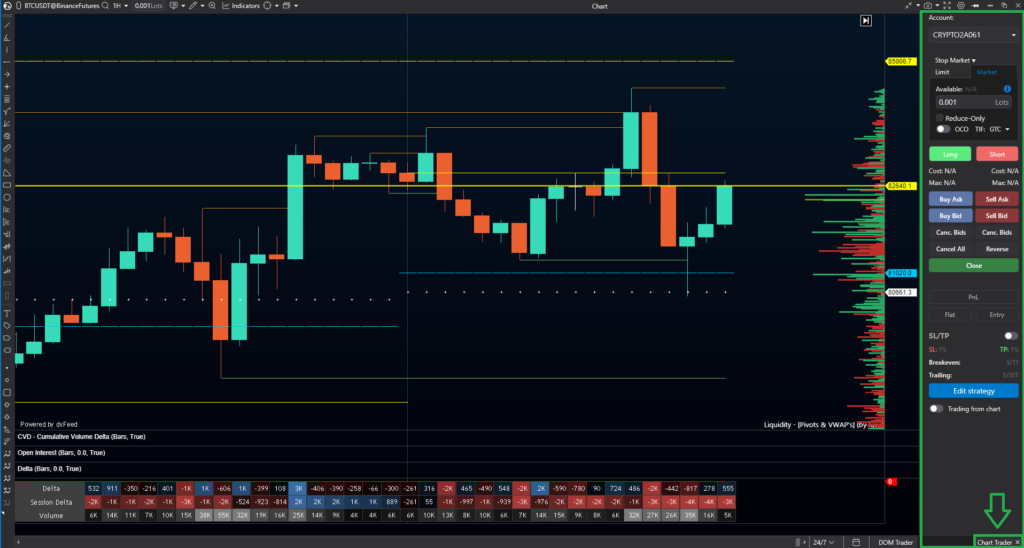
Now activate Chart Trader; this panel allows you to execute long and short trades directly from the template.
Tip: All cryptocurrencies available on Binance Futures can be used for demo trading in ATAS.
Step 4: Connect to a Demo Trading Account for Futures
You can also practise futures trading using a simulated account inside ATAS, perfect for testing assets like ES, NQ, or CL before going live.
Here’s how to set it up:
- Go to Connections, click Add, and select ATAS Sim.
- Connect it (optionally tick “Auto Connect” so it activates automatically every time you open ATAS).
- Choose your data feed. ATAS includes a built-in DxFeed option with a 15-minute delay. It’s fine for basic practice, but not ideal for real-time analysis.
– For real-time paper trading, connect a live feed like CQG, Rithmic, or DxFeed (paid options). - Open a chart for your preferred futures instrument (e.g., ES or NQ).
- Enable Chart Trader and begin paper trading.
Quick Tip: If you’re using the delayed DxFeed, right-click the chart and select Refresh to update the last traded price. For real-time execution, subscribe to a live feed.
Step 5: Practise and gain Experience
Once your demo trading account is ready, treat it seriously.
Here’s how to make your practice effective:
- Use your trading plan every time you trade. Don’t trade without a plan!
- Track your entries, exits, and emotions in a journal.
- Focus on risk management, which is crucial to survive in the markets.
- Review your performance weekly to identify what works.
This will help you build discipline and prepare you for the emotional side of live trading.
Free ATAS Install and Setup Course with Chart Champions
Learning to use a platform like ATAS may be challenging, but we’ve got you covered at Chart Champions! We have dedicated a learning module to ATAS, where you will also have an introduction to our exclusive templates.
What You Will Learn?
- ATAS Installation and account setup.
- Connecting your broker and data feed (for real accounts).
- Adding templates and snapshots in ATAS.
- Creating a workspace with Level 2 data and Smart Tape in ATAS.
- Introduction to: Order Flow Template, Sessions Template and Classic TPO template.
- Tips and tricks.
Check out our free course here:
Conclusion
Your demo trading account is more than just a place to practise; it’s where you develop the habits, patience, and discipline that define every successful trader.
Treat each session as training for the real market, log every trade, and focus on consistency and risk management over profits.
Your number 1 job is protecting your capital.
When you’re ready to move beyond simulation, take your next step with confidence and with a structured plan built on experience.
Enjoy all our free content and master ATAS with Chart Champions.
See you inside!